





A comprehensive guide to noise impact assessments
Being told that you need a Noise Impact Assessment can feel like another hurdle in an already complex and long-winded planning process. But the good news is that Noise Assessments are relatively straightforward to complete, and they could actually save you money in the long run.


We’ve put together this comprehensive guide covering everything you need to know about Noise Impact Assessments, including when an assessment is required, what happens during the assessment, and how they can help to reduce planning risks and keep your project moving.
What is a Noise Impact Assessment?
A Noise Impact Assessment (NIA) is a technical assessment that’s commonly carried out when a business, developer or individual is seeking planning permission for a project that could alter the acoustic environment around it. For residential schemes, it may also be required to understand whether future occupants could be affected by existing noise sources, such as roads, railways, commercial premises or plant equipment.
A NIA helps to establish three key things:
- What the current acoustic environment is like
- The risks to people who are already living or working nearby
- The risks to those who will live in or use the development
When is a Noise Impact Assessment required?
If your development may create additional noise or introduce new occupants to an existing noise source, then you may be asked to complete a NIA. For example, if you’re planning to build new homes near a busy road, railway line, commercial premises or an industrial estate, then your local planning authority will want confirmation that future occupants will not be exposed to unacceptable noise levels.
Careful acoustic assessment planning may also be needed if you’re planning a school, hospital, care home, or other noise-sensitive receptors where occupants are more vulnerable to disturbance. Commercial or industrial developments that generate noise, such as factories, warehouses, workshops, entertainment venues, restaurants or gyms, may also require this type of assessment to ensure the current local residents will not be exposed to unacceptable noise levels.
Plant noise is another key trigger. New HVAC systems, extract fans, generators and air source heat pumps can all affect nearby receptors. If you’re proposing to install new plant, your planning authority may request a NIA to demonstrate that the noise levels will remain within acceptable limits.
What does a Noise Impact Assessment involve?
1) Understanding the specific project risks
The first step in the assessment process is understanding exactly what your development involves, who or what could be affected by noise, and what evidence your planning authority is likely to require. This includes identifying nearby noise-sensitive receptors, as well as future occupants who may be exposed to existing noise sources.
2) Carrying out a noise survey
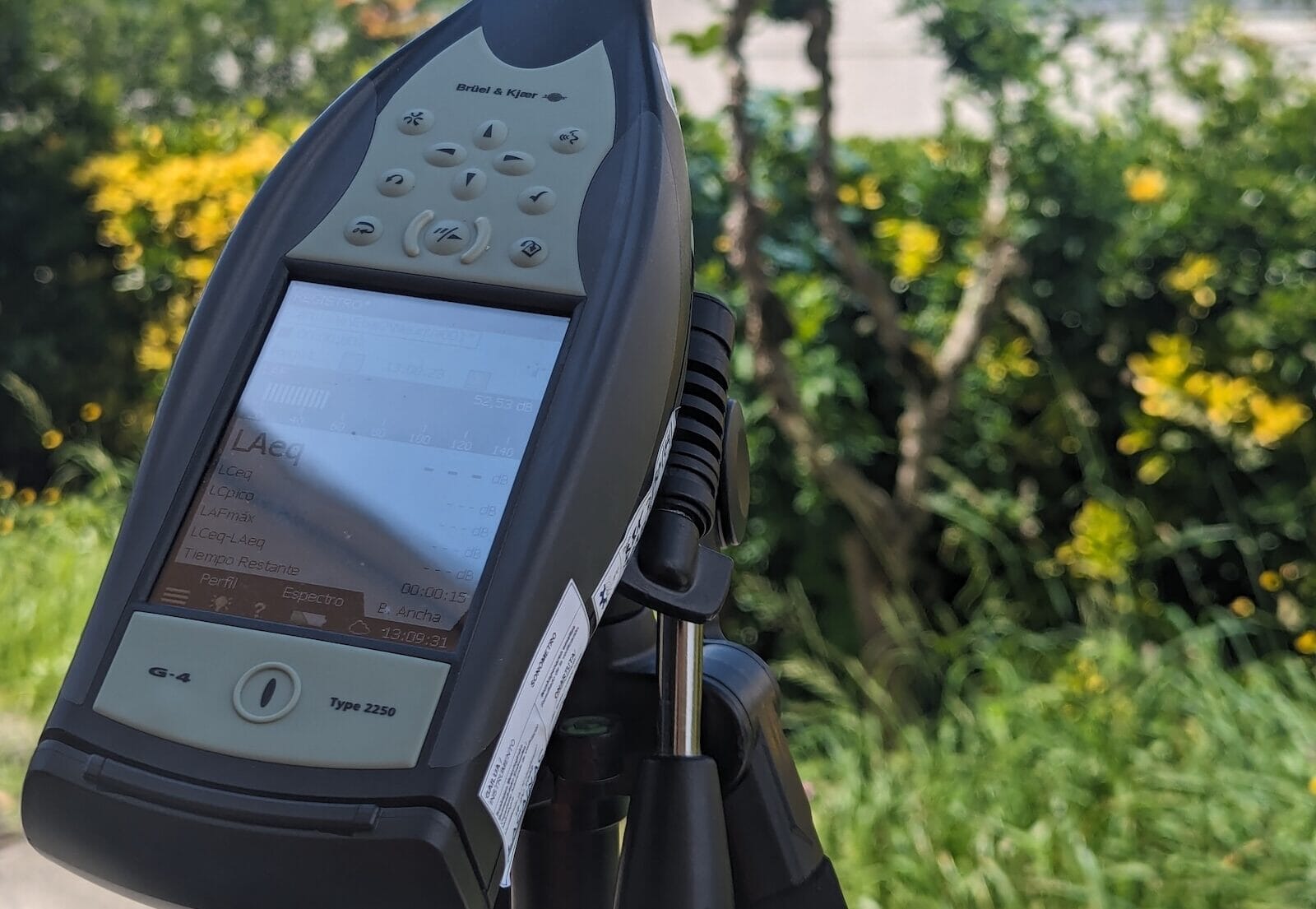
An experienced Acoustic Consultant will visit your site and install calibrated sound level meters. These are recording devices that are designed to capture and categorise sound by frequency, amplitude, and other acoustic characteristics. They will need to gather enough baseline data to understand the existing acoustic environment before the proposed plant or development is introduced.
3) Assessing the results against the relevant standards
Once the survey has been completed, the data is then processed and organised into the criteria needed for the assessment. BS 4124:4014+A1:2019 is typically used to assess whether mechanical or industrial plant is likely to have an adverse impact on the existing acoustic environment, whereas BS 8233:2014 is more common for residential schemes that need to consider internal noise levels, glazing, ventilation or facade design.
4) Setting noise limits and checking plant data
The background noise data will then be used to set appropriate limits at the most exposed noise-sensitive receptor. The Acoustic Consultant will review the plant noise information, including manufacturer data or design information from your mechanical team, to calculate whether the combined or cumulative plant noise would sit above or below those limits at the relevant receptor facade.
5) Preparing the noise survey report
Your consultant will then issue a final noise survey report, which brings all the evidence together in a format suitable for the planning authority. It explains the survey method used, the assessment results, relevant standards, and any recommended noise mitigation you may need to carry out to support the planning application or discharge a planning condition.

What happens if noise levels are too high?
If the assessment shows that noise levels on your development will exceed the required limits, then you’ll need to consider mitigation measures to lessen these impacts. For example, you may be required to:
- Install acoustic barriers
- Put enclosures around plant
- Add attenuators to intake or exhaust points
- Select quieter equipment
- Restrict your operating hours
- Improve the facade design
- Change the location or orientation of your equipment
It’s important that you address these issues early on. If plant noise is calculated to be louder than the agreed limits, your Acoustic Consultant will liaise with your developer, architect, or mechanical engineer to identify the most cost-effective solutions that meet the required noise limits without overcomplicating your design.
In some cases, you may need to complete updated calculations or modelling to confirm that the mitigation measures will achieve the performance required. This can be submitted as part of your planning application or to discharge a planning condition.
Expert Noise Impact Assessments from Encon Associates
Our expert Acoustic Consultants provide Noise Impact Assessments and Noise Management Plans for all types of projects to help you minimise noise disruption during both construction and occupation.
We combine on-site noise monitoring with advanced modelling software to assess all potential noise impacts on your future building occupants, workers, and the surrounding communities. We’ll assess your project against all key requirements, including your local authority noise criteria, the required British Standards, and relevant BREEAM credits such as Hea 05 and Pol 05. And if we identify any noise risks, we’ll work with your design team to develop practical mitigation strategies that will help you maintain an acceptable acoustic environment.
Need help reducing noise on your development? Get in touch to discuss your project requirements.
Call: 01159 875 599 or email:
A Noise Impact Assessment is required for developments near transport links, entertainment venues, or other high-noise environments. It is also necessary for all residential, commercial, or industrial projects that are expected to generate significant noise emissions.











Encon are a forward thinking company that take our commercial concerns as a developer into account without compromising on sustainability. They are enthusiastic, punctual and thorough in all the work they do for us.
